
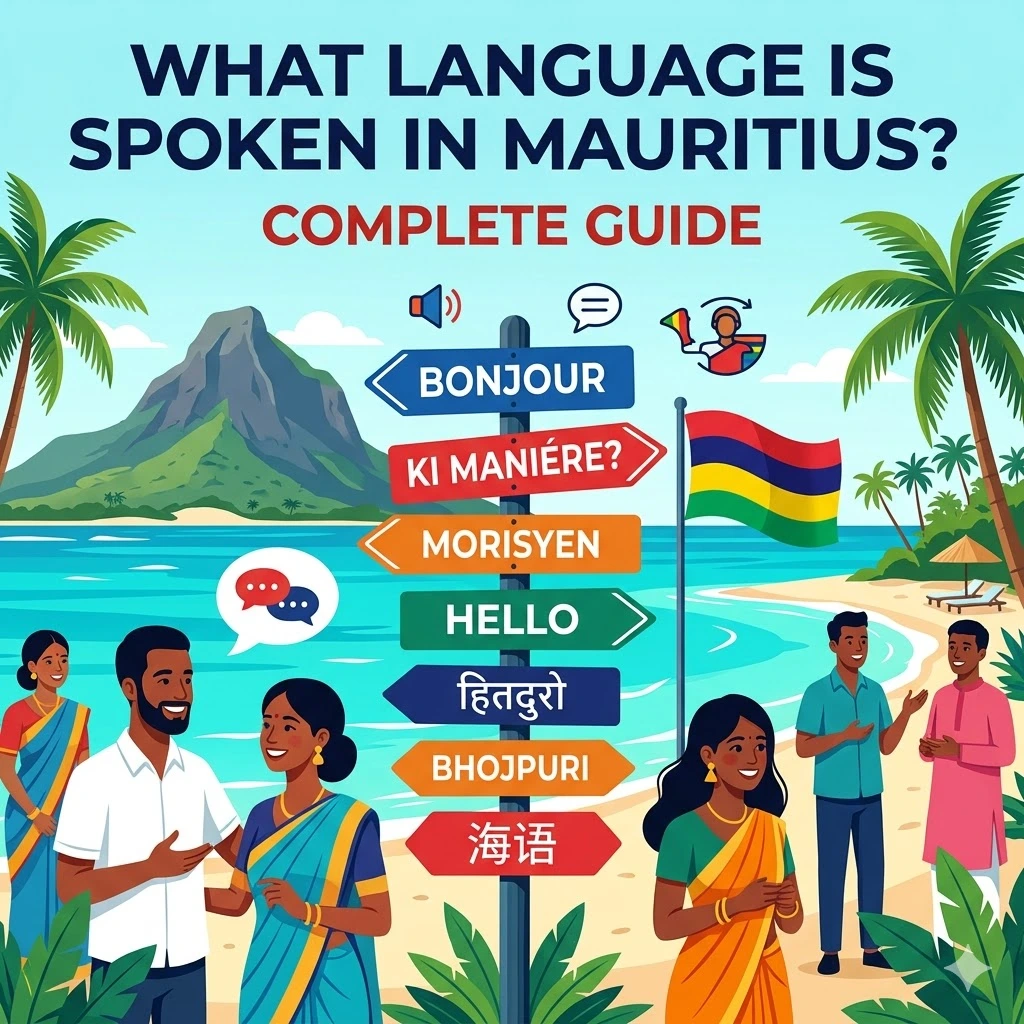
Mauritius operates as a highly multilingual society where Mauritian Creole serves as the everyday lingua franca for 90% of residents, yet English functions as the official administrative language while French dominates media and business.
This blend of languages in Mauritius creates a unique trilingual environment where most Mauritians fluently speak three languages by adulthood, often adding ancestral languages (Bhojpuri, Hindi, Tamil, Mandarin) depending on ethnic heritage within the island’s diverse population composition, including:
- Indo-Pakistani (67%)
- Creole (27%)
- Chinese (3%)
Three Main Languages Spoken Daily in Mauritius
Mauritian Creole (Morisien): Native Everyday Language
Mauritian Creole ranks as the heart language spoken by 90% of the population as primary home communication. French-based patois incorporating African, Asian, English, and Portuguese influences, creating a distinctive island linguistic identity developed during colonial periods when enslaved populations and indentured laborers from diverse origins created a common communication system.
Creole functions as a true mother tongue taught from birth in homes across all ethnic communities, serving as a social bonding language among friends, family gatherings, street markets, and informal workplace conversations.
Despite 90% daily usage, Creole lacks official language status and rarely appears in formal written documents, government communications, or educational materials, yet its cultural significance remains paramount as an authentic expression of Mauritian identity, distinguishing the island from other former French or British colonies.
Visitors attempting basic Creole phrases (“Bonzur” for hello, “Mersi” for thank you, “Ki manier?” for how are you) receive warm appreciation from locals recognizing respectful cultural engagement beyond typical tourist English-only interactions.
Essential Mauritian Creole Phrases:
| Basic Creole Phrase | English Meaning | When to Use |
| Alo! | Hello! | Casual greetings |
| Bonzur | Good morning/day | Formal morning greetings |
| Ki manier? | How are you? | Casual conversation starter |
| Korek | I’m doing well | Response to “Ki manier?” |
| Mersi boku | Thank you very much | Showing gratitude |
| Silvouple | Please | Polite requests |
| Orevwar | Goodbye | Departures |
| Komie sa koute? | How much is this? | Shopping, markets |
| Nou ale! | Let’s go! | Starting activities |
| Extra bon | It’s super good! | Complimenting food |
English: Official Administrative Language in Mauritius
English holds official language status used in Parliament, government administration, legal systems, and primary education, yet surprisingly spoken by a small percentage of the population in daily casual contexts outside formal settings.
Schools conduct instruction in English from the primary level onward, creating widespread comprehension across younger generations, while tourism industry workers maintain strong English fluency serving international visitors expecting English-speaking service at hotels, restaurants, attractions, and taxi transfers connecting the airport to accommodations.
Travelers speaking only English navigate Mauritius successfully without French or Creole knowledge: “Hello, how are you?” signals to locals which language to use in response, with most service industry professionals switching comfortably between English, French, and Creole depending on visitor preferences.
However, venturing beyond tourist zones into local markets, Port Louis Central Market street food stalls, or rural villages reveals English usage declining among elderly residents and traditional vendors who primarily communicate in Creole or ancestral languages.
French: Media, Business & Social Status Language
French dominates the media landscape (newspapers, television, radio), business communications, legal documentation beyond Parliament, and upper-tier educational institutions (lycées). Approximately one-third of the population uses French regularly despite no official status, with Franco-Mauritian elite and educated professionals maintaining French as a prestige language signaling social status and educational achievement.
Visitors speaking French communicate effortlessly across the island at restaurants, shops, malls, hotels, and attractions where French fluency equals or exceeds English availability.
Mauritian Creole’s French linguistic base (approximately 80-90% vocabulary derived from French) enables French speakers to understand basic Creole conversations quickly, phrases like:
- “Bonzur” (Bonjour)
- “Mersi” (Merci)
- “Silvouple” (S’il vous plaît)
These phrases demonstrate clear French origins with pronunciation variations. French-speaking visitors report seamless Mauritius experiences requiring minimal language adjustment compared to English-only travelers, encountering occasional communication gaps in non-tourist areas.
Ancestral & Community Languages Across Ethnic Groups
Bhojpuri: Indo-Mauritian Heritage Language
Bhojpuri is an Indo-Aryan language from the Bihar and Uttar Pradesh regions (India). Bhojpuri was historically spoken by one-tenth of the population, primarily among older generations descended from 19th-20th century indentured laborers.
Younger Mauritians increasingly abandon Bhojpuri learning, creating a generational language shift where grandparents speak Bhojpuri + Creole + French while grandchildren speak Creole + English + French without ancestral language retention.
Traditional Indian weddings, religious ceremonies (Hindu temples), and rural agricultural communities maintain Bhojpuri usage, particularly among elderly field workers and home-ceremony cooks speaking predominantly Bhojpuri mixed with Creole expressions.
Hindi, Tamil, Telugu, Urdu, Marathi: Media & Religious Languages
Hindi/Urdu maintains its presence through the popularity of Bollywood entertainment. Many Mauritians enjoy Hindi films, television shows, and radio programming despite not speaking Hindi fluently in daily life, creating passive comprehension among younger generations exposed to Indian media content.
Tamil, Telugu, Marathi, and other Indian languages function within specific ethnic community homes and religious contexts (temples, festivals), yet rarely appear in broader public domains beyond specialist media programming.
Mandarin, Hakka, Cantonese: Sino-Mauritian Community Languages
Chinese languages (Mandarin, Hakka, Cantonese) persist within 3% Sino-Mauritian population concentrated in Port Louis’s Chinatown district and family businesses. Third and fourth generation Sino-Mauritians increasingly adopt Creole + French + English trilingualism while maintaining limited ancestral language competency primarily among older family members and recent immigrants from China.
Typical Mauritian Multilingual Combinations
Most Mauritians speak at least three languages by adulthood through natural exposure and an educational system supporting a wide range of language instruction. Common language combinations include:
Older Generation (60+ years):
- Creole + Bhojpuri/Hindi + French
Middle Generation (30-60 years):
- Creole + English + French
Younger Generation (Under 30):
- Creole + English + French + ancestral language (optional)
Tourism/Business Professionals:
- Creole + English + French (fluent in all three)
The educational system teaches English from primary school, creating a generation of young Mauritians comfortable with code-switching between three languages within single conversations.
Sentence starting in Creole, switching to English for technical terms, ending in French for emphasis represents typical multilingual fluency, displaying remarkable linguistic adaptability uncommon in monolingual societies.
Language Advice for Visitors & Travelers
English-Only Speakers: Navigate successfully across tourist areas, hotels, restaurants, shopping centers, and attractions. Introduce yourself in English (“Hello, how are you?”), allowing locals to respond appropriately in English rather than French or Creole.
French Speakers: Experience seamless communication island-wide beyond tourist zones. French comprehension widespread across all age groups and socioeconomic levels, enabling authentic local interactions at markets, smaller restaurants, and rural areas where English usage declines.
Creole Learners: Earn local appreciation attempting basic phrases, like: “Bonzur” (hello), “Mersi” (thank you), “Ki manier?” (How are you?), and “Korek” (I’m fine) create positive impressions showing cultural respect beyond typical tourist language laziness, expecting English everywhere.
Multilingual Travelers: Maximize Mauritius exploration combining English (formal settings, hotels), French (restaurants, shops, business), and Creole (markets, taxis, friendly conversations). Linguistic flexibility unlocks deeper cultural understanding and warmer local reception across diverse island communities.
Cultural & Religious Diversity Shaping Language Use
Mauritius’ religious composition is an amazing blend of the following:
- 48% Hindu
- 32% Christian (majority Roman Catholic)
- 17% Muslim
- 3% Buddhist
This blend creates multilingual religious contexts where Hindi appears in Hindu temples, Latin/French in Catholic churches, Arabic in mosques, yet Creole serves as a common communication language uniting all communities beyond specific religious ceremonies. Cultural festivals (Diwali, Eid, Christmas, Chinese Spring Festival, Cavadee) celebrate the island’s diversity through multilingual announcements, signage, and celebrations demonstrating the peaceful coexistence of multiple linguistic and religious traditions within the compact 2,040-square-kilometer island nation.
Conclusion
Your Mauritius adventure unfolds through linguistic diversity, where three-language fluency creates a welcoming environment for English speakers, French communicators, and adventurous Creole learners, whether ordering dholl puri at Port Louis markets, booking catamaran cruises to Île aux Cerfs, or exploring Chamarel’s natural wonders. Linguistic flexibility enhances every interaction, transforming standard tourism into an authentic cultural exchange.

