
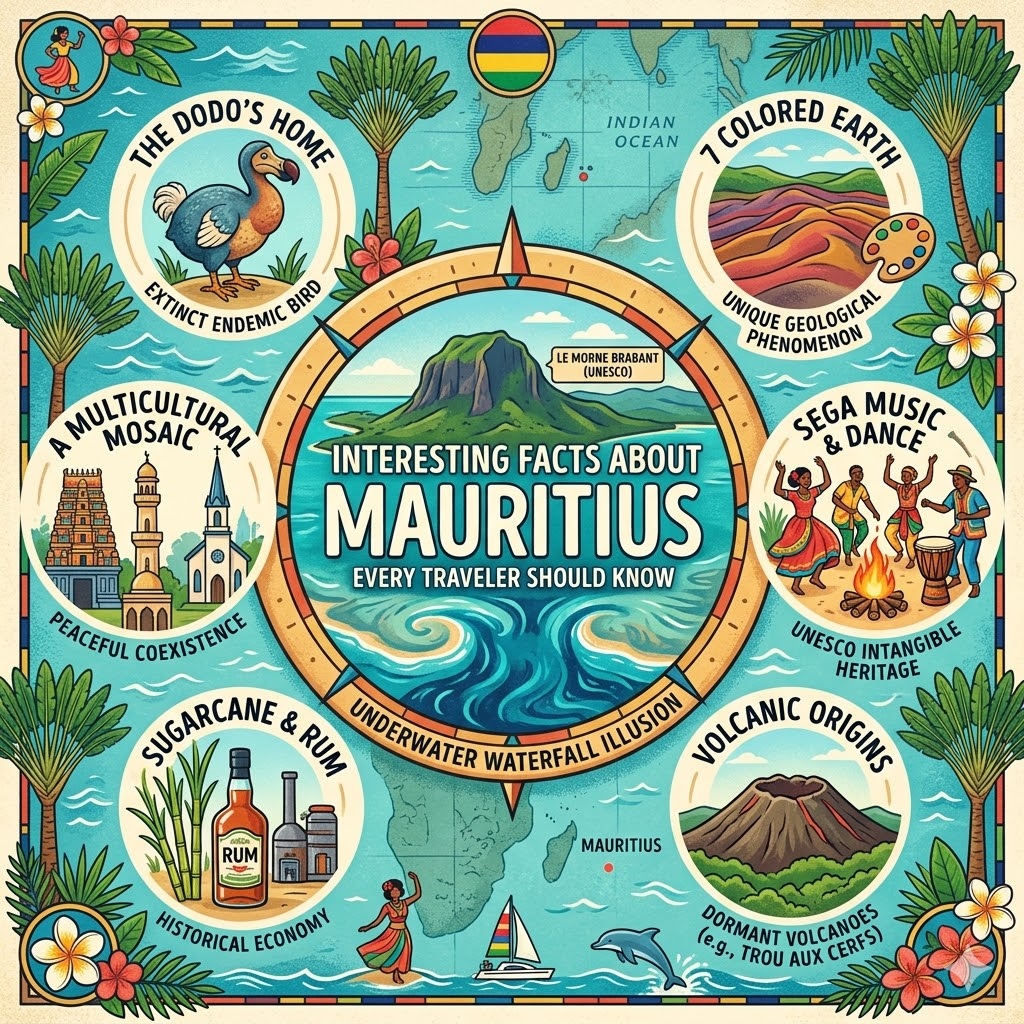
The core 3 interesting facts about Mauritius every traveler should know before visiting are that Mauritius operates without an official language, lacks a standing army, and requires specific travel preparations distinct from those of island destinations.
Your Mauritius journey begins the moment your flight touches down at Sir Seewoosagur Ramgoolam International Airport (MRU), located 48 kilometers southeast of Port Louis, the capital. Airport arrivals require immediate taxi in Mauritius for hotel transfers across northern resorts (Grand Baie, Trou aux Biches), western beaches (Flic en Flac, Tamarin), eastern lagoons (Belle Mare, Trou d’Eau Douce), or southern properties (Le Morne, Blue Bay) in just 30-90 minute drives depending on accommodation location.
MoRide’s airport transfer service in Mauritius eliminates post-flight stress through fixed-price bookings, flight monitoring, adjusting pickup times for delays, and professional drivers waiting at the arrivals hall with personalised name boards, ensuring seamless transitions from international travel to tropical relaxation within minutes of baggage collection.
Once settled at your accommodation, island exploration requires understanding Mauritius’ unique geographic and climate patterns. It helps you decide optimal timing for beach visits, mountain hikes, waterfall excursions, and catamaran cruises across diverse coastal regions.
Geographic & Climate Facts Mauritius Travelers Must Understand
Geographic facts about Mauritius travelers must understand include volcanic formation occurring 8 million years ago, creating discontinuous mountain ranges encircling a central plateau rising to 828 meters (2,716 feet) at the highest point. Trade winds blow from the southeast year-round, establishing climate patterns where eastern and southern regions receive cool winds with rainfall, while northern areas remain protected by mountains, creating distinct microclimates affecting travel planning.
Summer spans November through April with cyclone risks, while winter extends May through October with anti-cyclones bringing wind and rain rarely causing major damage. Coastline stretches 177 kilometers (110 miles), surrounded by coral reefs, producing calm, sandy-white beaches concentrated in northern zones ideal for swimming and water sports.
Mauritius Geographic Data:
| Mauritius Island | Total Area | 2,040 km² (790 sq mi) |
| Mauritius Island | Coastline Length | 177 km (110 miles) |
| Mauritius Island | Highest Elevation | 828 meters (2,716 feet) |
| Mauritius Island | Formation Age | 8 million years (volcanic) |
| Mauritius Climate | Summer Season | November–April (cyclones) |
| Mauritius Climate | Winter Season | May–October (anti-cyclones) |
Language & Communication Facts for Mauritius Visitors
Language & communication facts about Mauritius every traveller should know is that there is no official language in Mauritius, yet Mauritian Creole serves as the universal spoken language across all communities, derived from French with African, Asian, and Portuguese influences. English functions as the business and administrative language taught in schools, while French dominates media and formal written communication.
Hindi, Bhojpuri, Urdu, Mandarin, and Hakka represent minority languages spoken within specific ethnic communities totaling 68% Indo-Mauritian, 27% Creole (mixed African-European), 3% Sino-Mauritian, and 2% European heritage populations.
Literacy rate reaches 91.3%, ensuring most residents communicate effectively in at least 2-3 languages, including English and French comprehension assists travelers navigating restaurants, hotels, and attractions without language barriers requiring translation services.
Currency & Payment Facts Travelers Need for Mauritius
Currency & payment facts about Mauritius every traveler should know is that Mauritius specifies Mauritian Rupee (MUR) as the only accepted legal tender. MUR is distinct from the Indian Rupee despite naming similarity.
Exchange rates fluctuate between 40-46 MUR per 1 USD (March 2026 rates), requiring currency conversion at Sir Seewoosagur Ramgoolam International Airport, Port Louis banks, or authorised exchange bureaus displaying official licensing. Credit cards (Visa, Mastercard) function at hotels, upscale restaurants, and shopping centers, while cash remains mandatory for street food vendors, local markets, and taxi services in Mauritius operating in Port Louis, Grand Baie, Flic en Flac, and rural areas. ATMs dispense MUR denominations island-wide, charging 2-3% foreign transaction fees plus home bank charges. Travelers withdraw 5,000-10,000 MUR per transaction, minimising fee accumulation during 7-14 day visits.
Transportation Facts About Mauritius Taxis & Public Options
Facts about transportation and taxis in Mauritius reveal that no metered taxis operate island-wide, requiring fare negotiation before departure or booking fixed-price transfers through licensed operators like MoRide, offering transparent pricing via WhatsApp +230 5258 0813.
Public buses run extensively across 9 districts with routes connecting Port Louis (capital) to Grand Baie (north), Flic en Flac (west), Mahébourg (southeast), and Black River (southwest) at fares between 25-60 MUR per journey. However, limited schedules (operating 05:30-20:00 daily) and infrequent rural service make taxis in Mauritius essential for airport transfers, hotel pickups, attraction visits, and evening transportation.
Metro Express light rail connects Port Louis to Curepipe (central plateau), serving 13 stations since 2019, yet covers limited tourist destinations requiring supplementary taxi in Mauritius coordination for complete island exploration, including Chamarel Seven Coloured Earth, Le Morne Brabant, Île aux Cerfs catamaran departures, and northern island snorkeling sites.
Mauritius Transportation Comparison:
| Transport Type | Coverage | Operating Hours | Average Cost (MUR) |
| Public Buses | Island-wide (9 districts) | 05:30–20:00 daily | 25–60 per journey |
| Metro Express | Port Louis–Curepipe only | 06:00–20:00 daily | 20–50 per journey |
| Taxi Services | Complete island access | 24/7 availability | 800–3,000 per trip |
| Car Rental | Self-drive island-wide | Pick-up dependent | 1,500–3,500 per day |
Exploring Mauritius’ diverse attractions, from pristine beaches to volcanic landscapes, requires reliable transportation. MoRide’s taxi service in Mauritius coordinates seamless hotel-to-attraction transfers across all 9 districts with professional drivers, fixed pricing, and 24/7 WhatsApp booking at +230 5258 0813.
Cultural & Historical Facts Mauritius Travelers Should Respect
Cultural and historical facts about Mauritius every traveler should know, and respect include right-hand gift receiving protocol, as left hands represent uncleanliness in Indo-Mauritian Hindu and Muslim traditions comprising 68% of the population.
Religious diversity spans Hinduism (48%), Christianity (32%), Islam (17%), and Buddhism (3%). Such diversity creates a year-round festival celebration, including Divali, Eid, Christmas, Chinese Spring Festival, Cavadee, and Maha Shivaratree, where public holidays close businesses, requiring planning for shopping, dining, and attraction access.
Historical significance includes 2 UNESCO World Heritage Sites: Aapravasi Ghat (Port Louis) documenting 19th-century indentured labor immigration from India, and Le Morne Cultural Landscape (southwest) commemorating 18th-19th century slave refuge caves beneath Brabant Peak’s 556-meter summit.
Séga music represents national cultural identity originating from African slave communities, performed with ravanne (goat-skin drum), maravanne (rattle), and triangle instruments. Live Séga performances occur at beachfront hotels, cultural centers, and tourist restaurants, showcasing traditional hip-swaying, foot-shuffling dance movements.
Wildlife & Nature Facts About Mauritius Ecosystems
Wildlife and nature facts about Mauritius every traveler should know are that the Island’s ecosystems reveal the Dodo bird as the national animal despite its extinction in 1681. Its existence serves as a global symbol of human-caused species loss through hunting and invasive predator introduction (dogs, rats, pigs).
Endemic birds surviving on the Island include the Pink Pigeon, the Mauritius Kestrel, Mauritius Parakeet. All are critically endangered, requiring conservation protection within Black River Gorges National Park’s 6,574 hectares of native forest.
Flora comprises 335 endemic flowering plants with Trochetia Boutoniana (national flower) displaying bell-shaped red blooms resembling earrings (“Boucle d’Oreille” in French). Pamplemousses Botanical Garden (established 1770) hosts giant Victoria Amazonica water lilies spanning 2-meter diameters and Talipot palm trees flowering once between 30-80 years before dying, visitable year-round with 200 MUR adult admission providing botanical education and photography opportunities.
Unique Natural Phenomena Facts: Travelers Visit Mauritius to See
Unique natural phenomena facts travelers visit Mauritius to see feature the underwater waterfall illusion off Le Morne Peninsula’s southwest coast, created by powerful ocean currents driving sand and silt deposits down coastal shelf drop-offs into darker depths, viewable via helicopter tours, including the following ones:
- MUR 18,500 ($450) for 15-minute flights
- Catamaran cruises departing Black River and Le Morne embarkation points at MUR 3,000-7,000 ($75-$170) per person for full-day shared experiences.
Chamarel Seven Coloured Earth Geopark displays 600-million-year geology through violet, yellow, red, blue, green, brown, and purple sands layered across 7,500-square-meter dunes formed by volcanic rock weathering and mineral oxidation. Entry costs 250 MUR adults (150 MUR children ages 3-11) with operating hours 08:30-17:30 daily, including giant tortoise enclosures and 100-meter Chamarel Waterfall viewpoints.
These geological marvels require taxi in Mauritius transportation from hotels island-wide, as public buses serve Chamarel village 4 kilometers from geopark entrance necessitating uphill walking unsuitable for elderly travelers, families with young children, or visitors carrying camera equipment.
Discovering Mauritius’ Seven Coloured Earth, waterfalls, and natural wonders across the southwestern regions becomes effortless with MoRide’s South Mauritius tour, combining Chamarel Geopark, rum distillery tastings, Black River Gorges viewpoints, and Tamarin Falls in comfortable air-conditioned vehicles. Book customised itineraries via WhatsApp +230 5258 0813.
Essential Travel Preparation Facts for Mauritius First-Time Visitors
Essential travel preparation facts for first-time Mauritius visitors include visa-free entry for 90 days granted to citizens from 115 countries (USA, UK, EU, Australia, Canada, South Africa, India, China) upon passport presentation at Sir Seewoosagur Ramgoolam International Airport. Electrical outlets in Mauritius use Type C and Type G plugs operating at 230V/50Hz, requiring universal adapters for American (Type A/B) and Australian (Type I) devices, available at airport shops, hotel receptions, and Winner’s/Jumbo supermarkets island-wide at 150-300 MUR per adapter.
Tap water remains non-potable due to aging pipe infrastructure and mineral content, causing digestive upset in unaccustomed visitors. Bottled water costs 25-40 MUR per 1.5-liter bottle at supermarkets, 50-80 MUR at hotels and restaurants, with daily consumption recommendations reaching 2-3 liters under tropical heat and humidity averaging 25-33°C (77-91°F) year-round.
Mauritius Travel Essentials Checklist:
| Category | Requirement | Cost/Specification |
| Visa | 90-day visa-free (115 countries) | No cost. Passport only. |
| Electrical Adapter | Type C & Type G plugs | 230V/50Hz to 150-300 MUR |
| Currency | Mauritian Rupee (MUR) only | 40-46 MUR per 1 USD |
| Bottled Water | Non-potable tap water | 25-40 MUR per 1.5L |
| Sun Protection | SPF 50+ reef-safe sunscreen | 300-600 MUR per bottle |
| Transportation | Taxi, bus, or rental car | Negotiated fares/routes |
Conclusion
Ready to transform interesting Mauritius facts into unforgettable experiences?
Your tropical adventure awaits in Mauritius.
Pack your universal adapter, stock up on SPF 50+, download offline maps, and prepare taste buds for dholl puri explosions and vanilla tea serenity.
Mauritius doesn’t just welcome travelers, it embraces explorers ready to snorkel with sea turtles at 09:00 AM, hike Le Morne’s UNESCO slopes by midday, sample sugarcane rum at Chamarel distilleries come afternoon, then toast fiery Indian Ocean sunsets from a catamaran trampoline.

