
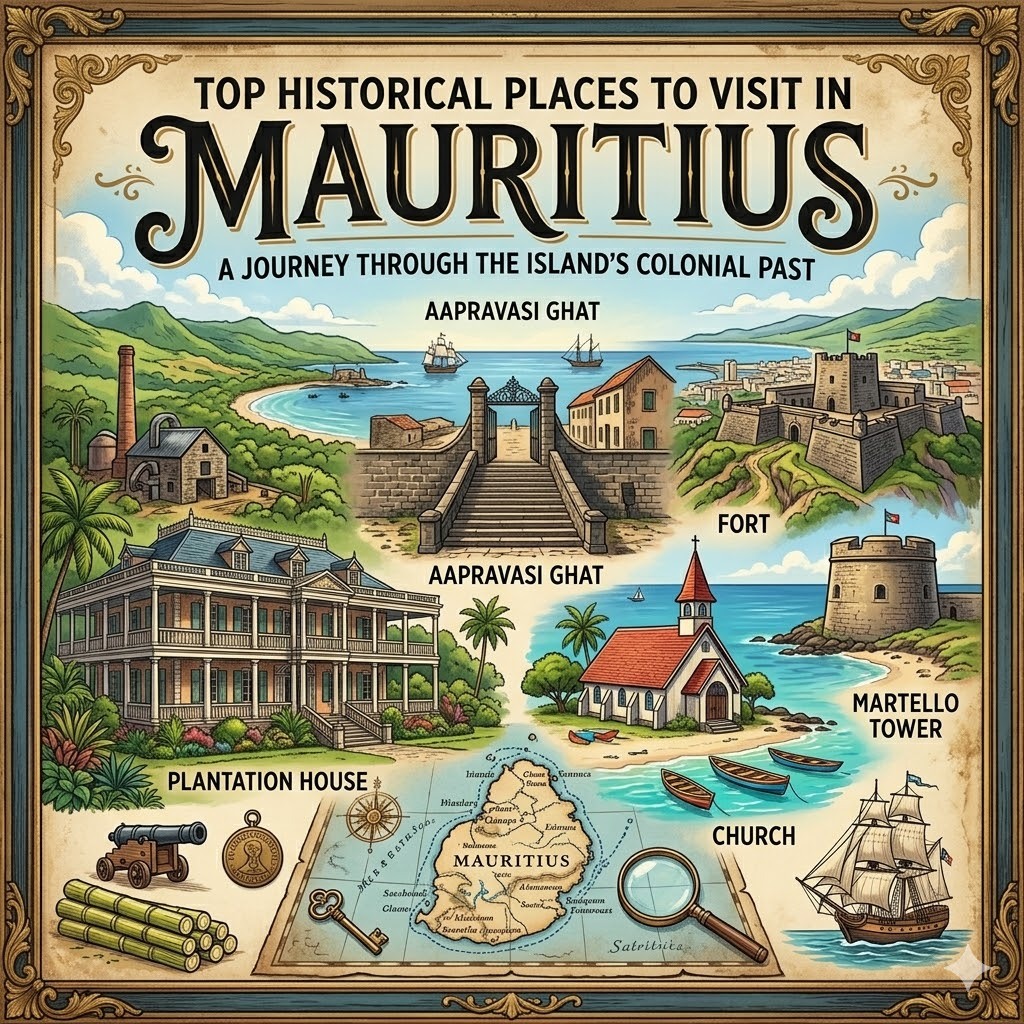
Mauritius is more than just an island and beaches. Each place in Mauritius highlights its rich 400-year colonial history spanning Dutch, French, and British rule, with preserved sites telling stories of slavery, sugar, and cultural fusion.
Today, let’s discover the top 9 historical places to visit in Mauritius, from colonial forts to UNESCO (United Nations Educational, Scientific, and Cultural Organization) sites. Explore centuries of culture and heritage.
1. Aapravasi Ghat: UNESCO World Heritage Immigration Depot
Top historical places Mauritius travelers visit to understand the island’s multicultural identity include Aapravasi Ghat, designated a UNESCO World Heritage Site in 2006, documenting the first British indentured labor immigration depot operating from 1849 to 1923.
The Ghat is located in Port Louis harbor. Aapravasi Ghat received 450,000 Indian indentured laborers between 1834 and 1920 following the abolition, establishing the “Great Experiment” where contracted workers replaced enslaved populations across British Empire colonies, including Fiji, South Africa, and Caribbean islands.
This site represents the global indentured labor system origins affecting 2 million people worldwide, making it among the critical UNESCO heritage sites explaining modern Mauritius’ 68% Indo-Mauritian population demographic. Preserved structures at the Ghat include original immigration depot stone buildings, arrival steps where laborers disembarked from ships, medical inspection rooms, and administrative offices displaying colonial-era documentation.
The Ghat’s visitor center exhibits feature interactive displays explaining contract terms (5-year agreements, return passage guarantees, daily wages), living conditions aboard ships enduring 3-4 month voyages from Calcutta and Madras ports, and integration challenges faced by arrivals speaking Hindi, Bhojpuri, Tamil, and Telugu languages.
Operating hours span 09:00-16:00 Monday-Friday, 09:00-12:00 Saturday, with free admission. Guided tours available in English, French, and Creole languages explaining architectural significance and personal immigrant stories through archival photographs and oral histories.
Aapravasi Ghat Essential Information:
| UNESCO Status | World Heritage Site (2006) |
| Operating Period | 1849-1923 (immigration depot) |
| Operating Hours | 09:00-16:00 Mon-Fri, 09:00-12:00 Sat |
| Admission Fee | Free entry |
| Location | Port Louis harbor waterfront |
| Guided Tours | English, French, and Creole are available |
Understanding Mauritian identity requires visiting Aapravasi Ghat, where indentured labor history shaped the nation’s religious diversity, which is Hinduism 48% and Islam, 17%. Read out our complete food guide, if you’re wondering what to eat in such cultural and religious sites in Mauritius.
2. Le Morne Brabant: Mountain of Memory and Freedom
Le Morne cultural landscape rises 556 meters above the southwestern peninsula. It was designated as a UNESCO World Heritage Site in 2008. The site commemorates maroon slave communities inhabiting rugged caves and ravines beneath its summit during the 18th-19th centuries.
Between 1730 and 1835, escaped slaves (maroons) established refuge settlements exploiting Le Morne’s cliffs, dense vegetation, and isolated location, protecting them from colonial authorities’ recapture attempts, creating symbols of resistance and freedom central to the Creole population’s cultural identity.
Slavery history in Mauritius reaches a tragic climax through the 1835 legend where a police expedition ascending Le Morne to announce abolition caused maroons to leap from cliffs believing recapture imminent, resulting in mass deaths commemorated annually during International Day for Abolition of Slavery (December 2nd).
Hiking trail details include a 3.5-kilometer one-way path with 556-meter elevation gain requiring 3-4 hours round-trip, moderate-challenging difficulty. Trailhead starts at Le Morne Public Beach, accessing forested slopes, exposed ridgelines, and summit plateau delivering 360-degree panoramic views across the southwestern coastline, Ilot Bénitiers, and Crystal Rock. Memorial site at mountain base features an interpretation center explaining maroon history, abolition timeline, and cultural significance through exhibits, while annual commemoration ceremonies include Creole music performances, traditional séga dancing, and wreath-laying honoring ancestors’ sacrifice.
Le Morne Brabant Access & Significance:
- Trail Distance: 3.5 km one-way (7 km round-trip with 556m elevation)
- Hiking Duration: 3-4 hours round-trip (moderate-challenging difficulty)
- UNESCO Status: World Heritage Cultural Landscape (2008 designation)
- Historical Period: 1730-1835 (maroon slave refuge and abolition era)
- Memorial Events: December 2nd annual commemoration (abolition remembrance)
- Access Point: Le Morne Public Beach trailhead (free parking available)
Exploring Le Morne and southwestern attractions, combining the UNESCO mountain, Chamarel geological wonders, and Black River coastal beauty, requires coordinated transportation. MoRide’s South Mauritius tour delivers comprehensive historical and natural site visits with professional guides explaining cultural significance.
3. Château de Labourdonnais: Colonial Mansion and Estate
Colonial architecture in Mauritius is showcased through the Château de Labourdonnais. It is a restored 19th-century neoclassical mansion built in 1856 by wealthy sugar plantation owner Christian Wiehe. The mansion is built on a 3,500-hectare estate located in Mapou village (northern district). Named in honor of Governor Bertrand-François Mahé de Labourdonnais (1735-1746, French colonial administrator), this mansion exemplifies French colonial heritage through Creole-style architecture featuring wide verandas, jalousie shutters, ornate ironwork balconies, and colonial-era furnishings, including Compagnie des Indes porcelain, mahogany furniture, and family portraits spanning four generations.
Restored interiors display period antiques across 12 rooms, including master bedrooms, dining halls, libraries, and servants’ quarters. Guided tours (45-60 minutes duration, 400 MUR adults / 200 MUR children) explain plantation economy, Franco-Mauritian aristocracy lifestyle, and architectural preservation efforts restoring the original 1856 structure damaged by cyclones.
Estate grounds encompass a working rum distillery producing Labourdonnais rhum agricole from estate-grown sugarcane, tropical fruit orchards (lychee, mango, pineapple varieties), and spice gardens. Visitors sample rum varieties (white, gold, spiced expressions) at the tasting room before dining at La Table du Château restaurant, serving contemporary Mauritian cuisine using estate-harvested ingredients.
Château de Labourdonnais Visitor Details:
| Feature | Specification |
| Construction Year | 1856 (neoclassical Creole mansion) |
| Estate Size | 3,500 hectares (original plantation) |
| Guided Tour Duration | 45-60 minutes (English/French available) |
| Admission Fee | 400 MUR adults, 200 MUR children |
| Operating Hours | 09:00-17:00 daily (last entry 16:00) |
| On-Site Facilities | Rum distillery, restaurant, orchards |
4. Fort Adelaide (La Citadelle): Victorian Military Stronghold
Port Louis attractions include Fort Adelaide, nicknamed La Citadelle. It was constructed in 1834-1840 under British colonial rule following the 1832 labor unrest and the cholera epidemic threatening the stability of colonial authority. British Royal Engineers built this site, employing 1,200 workers across a 6-year construction period.
This British colonial fort occupies a strategic hilltop position 240 feet above the Port Louis city center. Its octagonal star-shaped design follows Vauban military architecture principles with thick basalt stone walls, cannon embrasures, and strategic vantage points overlooking harbor approaches, government buildings, and mountain passes into the central plateau.
Fort Adelaide’s elevated position delivers panoramic 360-degree views encompassing Port Louis cityscape, SSR International Airport runways, Moka mountain ranges, and northern coastline extending toward Pamplemousses district. Such a 360-degree view makes it a prime photography location, especially in sunset hours (17:00-18:30 year-round).
Its fortification’s octagonal design features 8 corner bastions connected by curtain walls spanning a 600-meter perimeter, a central parade ground, officers’ quarters (now administrative offices), and underground powder magazines. Occasional cultural events include Independence Day celebrations (March 12th), Creole Festival performances, and open-air concerts utilizing the historic parade ground as a venue.
Fort Adelaide Access & Features:
- Construction Period: 1834-1840 (British colonial military project)
- Architectural Style: Octagonal star-fort following Vauban principles
- Elevation: 240 feet above Port Louis (hilltop strategic position)
- Operating Hours: 09:00-17:00 daily (free admission for rampart walks)
- Best Visiting Times: 16:00-18:30 for sunset photography and city views
- Accessibility: Steep access road requiring vehicle transport or fitness
Discovering Port Louis attractions, markets, and waterfront sites from Fort Adelaide, Caudan Waterfront, Central Market, to Aapravasi Ghat requires coordinated city navigation. MoRide’s North Tour covers capital highlights with traffic navigation expertise and flexible timing.
5. Eureka House: Creole Architecture and Colonial Lifestyle
Mauritian Creole house architecture peaks through Eureka House (La Maison Eureka), a 1830s colonial mansion located in the Moka district, showcasing distinctive 109 doors and windows spanning a two-story structure. Architectural features maximizing natural ventilation and light circulation were essential for tropical comfort before air conditioning technology.
It was built by British and French colonial planters. This colonial museum in Mauritius preserves the Franco-Mauritian aristocracy lifestyle through period furniture, including four-poster mahogany beds, rosewood dining sets, Compagnie des Indes porcelain collections, antique maps documenting colonial-era Mauritius, and family photographs spanning the 19th-20th centuries.
Guided tours (60-75 minutes duration, 300 MUR adults / 150 MUR children) explain Creole architectural elements, including wide verandas (varangues) encircling the structure, steep-pitched roofs with dormer windows, ornate fretwork (lambrequins) decorating eaves, and elevated construction on stone pillars preventing termite damage and cyclone flooding. Its estate gardens encompass 4 hectares, featuring endemic plants, a ravine waterfall accessible via forest trail, ornamental ponds, and restored colonial-era kitchen buildings.
Traditional Creole lunch option (600 MUR prix fixe menu) serves rougaille, daube, and coconut-based curries prepared following 19th-century recipes explaining Indo-African culinary fusion origins.
Eureka House Historical Experience:
| Construction Era | 1830s (early British colonial period) |
| Architectural Feature | 109 doors/windows (ventilation design) |
| Guided Tour Duration | 60-75 minutes (historical lifestyle focus) |
| Admission Fee | 300 MUR adults, 150 MUR children |
| Operating Hours | 09:00-17:00 daily (last entry 16:00) |
| Lunch Option | 600 MUR traditional Creole menu |
6. Robert Edward Hart Memorial Museum: Poet’s Sanctuary
Souillac attractions in southern Mauritius include the Robert Edward Hart Memorial Museum, preserving the beloved poet’s seaside cottage where he lived 1930-1954, composing verses celebrating Mauritian identity, Creole language, and Indian Ocean landscapes.
Robert Edward Hart (1891-1954) wrote extensively in English and French, becoming a national literary figure whose works explored colonial identity struggles, natural beauty observations, and philosophical reflections. His poetry anthologies (Poèmes Solaires, Le Cœur de l’Océan) remain studied in Mauritian schools as Mauritius cultural sites documenting early 20th-century intellectual movements.
Cottage setting overlooks dramatic Gris Gris cliffs where waves crash against basaltic rock formations, creating seafoam spray visible from Hart’s writing desk preserved inside the main room. Personal artifacts displayed at the museum include original manuscripts, a typewriter, spectacles, a walking stick, and correspondence with contemporary writers. Small garden surrounds cottage featuring tropical flowering plants (bougainvillea, hibiscus, frangipani) and a stone bench where Hart composed morning verses watching sunrise over the southern coastline.
The museum operates 09:00-16:00 Monday-Friday (free admission) with Gris Gris Beach, La Roche Qui Pleure viewpoint, and Rochester Falls located within a 5-kilometer radius, creating a combined southern coastal exploration itinerary.
Robert Edward Hart Museum & Surroundings:
- Poet’s Residency: 1930-1954 (24-year creative period at seaside cottage)
- Literary Significance: National poet documenting Mauritian identity formation
- Operating Hours: 09:00-16:00 Monday-Friday (free admission policy)
- Cottage Features: Original writing desk, manuscripts, personal artifacts
- Coastal Setting: Gris Gris cliffs with dramatic wave action views
- Nearby Attractions: Gris Gris Beach, La Roche Qui Pleure (1-2 km distance)
7. Saint Aubin House and Rum Distillery: Sugar Estate Heritage
Sugar plantation history comes alive at Saint Aubin House, a working sugar estate established in 1819, operating continuously for 205+ years, demonstrating the Mauritian economy’s agricultural foundations. Colonial house built in the 1870s showcases Victorian-era plantation owner lifestyle through preserved interiors, period furniture, and family portraits.
Guided tours (300 MUR adults / 150 MUR children, 45-minute duration) explain sugarcane cultivation cycles, rum production processes, and estate management systems employing hundreds of laborers during harvest seasons (July-December annually).
Mauritian rum distillery operations are visible through working facilities producing Saint Aubin rhum agricole from estate-grown sugarcane varieties. The production process follows traditional methods, including cane crushing, fermentation in wooden vats, copper pot-still distillation, and oak barrel aging, producing signature expressions (white, spiced, vanilla-infused rums).
Estate grounds encompass a vanilla plantation demonstrating hand-pollination techniques (each flower requires individual morning pollination between 06:00-10:00), anthurium flower gardens cultivating 50+ varieties exported internationally, and a boat house restaurant serving Creole cuisine overlooking an ornamental lake. Visitors purchase estate-produced rum, vanilla pods, and anthurium bouquets at the on-site boutique supporting estate sustainability.
Saint Aubin Estate Experience Components:
| Facility | Description | Cost/Duration |
| Colonial House Tour | Victorian-era interiors, furniture | 300 MUR / 45 minutes |
| Rum Distillery Visit | Traditional production process | Included in the house tour |
| Vanilla Plantation | Hand-pollination demonstration | Included (seasonal) |
| Anthurium Gardens | 50+ flower varieties cultivated | Free garden access |
| Boat House Restaurant | Creole lunch with lake views | 800-1,200 MUR per person |
8. Frederik Hendrik Museum: Dutch Settlement Origins
Dutch colonial period (1638-1710) documentation centers at Frederik Hendrik Museum, located in Vieux Grand Port, the site of the first permanent European settlement in Mauritius history. Named after Dutch Prince Frederik Hendrik of Orange-Nassau, this fortified settlement established in 1638 by the Dutch East India Company (VOC) served as a strategic resupply station for ships trading between the Netherlands and Batavia (Indonesia). Archaeological remains include fort foundations, warehouse structures, defensive walls, and pottery fragments excavated from 17th-century occupation layers.
The museum exhibits explain Dutch East India Company operations exploiting Mauritius’ natural resources, primarily ebony forests (harvested for the European furniture trade), tobacco cultivation (exported to Asian markets), and ambergris collection from beached sperm whales. Interactive displays detail why the Dutch abandoned Mauritius in 1710: cyclone destruction, rat plagues destroying crops, slave rebellions threatening plantation viability, and a more profitable Indonesian spice trade focusing company resources elsewhere.
Reconstruction models recreate 1640s-era fort layout, sailing ship designs transporting cargo, and daily settlement life, operating hours 09:00-16:00 Monday-Friday, 09:00-12:00 Saturday (100 MUR admission adults / 50 MUR children) with a naval battle museum nearby documenting the 1810 Grand Port French victory over British forces.
Frederik Hendrik Museum Historical Context:
- Dutch Settlement: 1638-1710 (72-year occupation period)
- Strategic Purpose: VOC resupply station (Netherlands-Batavia trade route)
- Primary Exports: Ebony wood, tobacco, ambergris, tortoise shells
- Abandonment Causes: Cyclones, pests, rebellions, resource depletion
- Museum Hours: 09:00-16:00 Mon-Fri, 09:00-12:00 Sat
- Admission Fee: 100 MUR adults, 50 MUR children
9. Grand Bassin (Ganga Talao): Sacred Hindu Pilgrimage Site
Religious sites in Mauritius include Grand Bassin, a sacred crater lake, known as Ganga Talao, meaning “Ganges Lake” in Hindi. Pilgrimage destination for the island’s 48% Hindu population, believing waters are spiritually connected to India’s holy Ganges River following a 1897 priest’s divine vision. Located in the central highlands at an elevation of 550 meters, this natural volcanic crater lake spans 1.5 kilometers in circumference, surrounded by temples dedicated to Shiva, Hanuman, Lakshmi, and other Hindu deities.
Most striking features include a 33-meter-tall Shiva statue (Mangal Mahadev, erected 2007) and a 20-meter Durga statue (erected 2008) flanking the lake entrance visible from the mountain approach roads.
Annual Maha Shivaratri pilgrimage occurs February-March (timing varies with lunar calendar), drawing 400,000+ devotees walking overnight from coastal towns carrying kanwars to reach the lake by dawn. Kanwar is a bamboo structure decorated with flowers, mirrors, and religious symbols. Pilgrims collect sacred water in brass containers, perform puja ceremonies at lakeside temples, and offer coconuts, milk, and flowers to deity statues, creating a Hindu heritage spectacle unmatched across Indian Ocean islands.
Non-pilgrimage visits (recommended weekdays 08:00-16:00) allow peaceful temple exploration, feeding sacred fish inhabiting the lake, and photography of statue monuments against a mountain backdrop. Modest dress required (covering shoulders, knees). Remove shoes before entering temple structures, photography permitted, excluding inner sanctums during active worship.
Grand Bassin Pilgrimage & Visitor Information:
| Elevation | 550 meters (central highland crater lake) |
| Lake Circumference | 1.5 kilometers (volcanic crater formation) |
| Major Statues | Mangal Mahadev (33m), Durga (20m) erected 2007-2008 |
| Maha Shivaratri | February-March annual pilgrimage (400,000+ devotees) |
| Daily Visiting Hours | 08:00-16:00 recommended (free admission) |
| Dress Code | Modest attire required (shoulders/knees covered) |
Planning Your Historical Tour: Practical Tips and Combinations
Visiting historical sites in Mauritius requires strategic heritage tour planning combining locations geographically to minimize driving time across 9 districts spanning 65-kilometer north-south, 45-kilometer east-west distances.
The Northern zone combines the Château de Labourdonnais (Mapou), the Pamplemousses Botanical Garden (15-minute drive), and Port Louis sites (Fort Adelaide, Aapravasi Ghat, 30-minute drive), completing a 6-hour northern historical circuit covering colonial architecture, immigration history, and military fortifications.
Southern-central zone combines Grand Bassin sacred lake (central highlands), Eureka House (Moka, 20-minute drive), Saint Aubin estate (southern plains, 35-minute drive), and Robert Edward Hart Museum (Souillac coast, 15-minute drive), creating comprehensive 7-8 hour itinerary exploring religious sites, plantation heritage, and coastal cultural attractions requiring early 08:00 departure maximizing daylight hours.
Visiting multiple historical sites across northern, central, and southern districts requires coordinated taxi in Mauritius. MoRide connects UNESCO sites, colonial mansions, and sacred temples with fixed-price transfers, eliminating navigation stress.
There are amazing things to do in Mauritius, including cultural diversity through religious sites, festivals, and temples reveals Indo-Mauritian heritage shaping modern island identity. Our complete activities guide covers spiritual destinations alongside natural attractions, creating comprehensive cultural understanding.
Suggested 2-3 Day Historical Itinerary:
Day 1 – Port Louis & North (6-7 hours):
- Fort Adelaide panoramic views (09:00-10:30)
- Aapravasi Ghat UNESCO site (11:00-12:30)
- Château de Labourdonnais with lunch (14:00-17:00)
Day 2 – Central & South (7-8 hours):
- Grand Bassin sacred lake (08:30-10:30)
- Eureka House colonial mansion (11:00-13:00)
- Saint Aubin estate with rum tasting (14:30-17:00)
Day 3 – Southwest Cultural Sites (5-6 hours):
- Le Morne Brabant memorial site or hiking (08:00-12:00)
- Frederik Hendrik Museum Vieux Grand Port (14:00-15:30)
- Robert Edward Hart Museum with Gris Gris sunset (16:00-18:00)
Entrance fees range from 100 to 400 MUR per site, averaging 1,500 to 2,000 MUR daily per person, including guided tours where available: Grand Bassin, Fort Adelaide ramparts, and Robert Edward Hart Museum, offer free admission, reducing budget constraints. Guided tour options through certified operators (MoRide, Mauritius Tourism Authority-licensed guides) provide historical context, multilingual expertise, and transportation coordination versus self-drive navigation requiring offline maps, parking arrangements, and timing flexibility, managing variable site operating hours.
Best visiting seasons span May-October (Mauritian winter), avoiding January-March cyclone season and April-May high humidity periods. Weekday mornings (09:00-12:00) deliver fewer crowds at popular sites like Aapravasi Ghat and Château de Labourdonnais. Respectful visiting etiquette at memorial sites (Le Morne, Aapravasi Ghat) includes quiet observation, photography restrictions inside UNESCO interpretation centers, and understanding historical trauma significance for Indo-Mauritian and Creole communities. Grand Bassin requires modest dress, shoe removal at temples, and refraining from photography during active worship ceremonies.
Reaching remote historical locations like Le Morne memorial site, Grand Bassin sacred lake, and Eureka House necessitates reliable taxi in Mauritius services. Public buses offer limited schedules and rural coverage unsuitable for comprehensive heritage exploration.
Conclusion
Visiting these top 9 historical sites in Mauritius transforms island appreciation from beach paradise perception into understanding complex heritage combining European colonization, African slavery, Indian immigration, and Creole identity formation. These experiences enrich beach vacations with educational depth and cultural respect.
Exploring Mauritius’ historical treasures requires reliable transportation, navigating mountain roads to Le Morne, coastal routes to Souillac, capital traffic to Port Louis, and central highlands accessing Grand Bassin. MoRide’s customized heritage tours coordinate seamless site visits across 2-3 day itineraries with professional drivers explaining historical context, managing entrance logistics, and optimizing timing for photography and guided tours.
Book a comprehensive historical exploration via WhatsApp +230 5258 0813, combining North tours covering Port Louis and Château de Labourdonnais with South Mauritius adventures exploring Le Morne, Saint Aubin, and coastal heritage sites. Your cultural journey through Mauritian history begins with expert taxi services delivering stress-free access to every UNESCO site, colonial mansion, and sacred pilgrimage destination island-wide.
Frequently Asked Questions
What are the UNESCO World Heritage Sites in Mauritius?
Mauritius has 2 UNESCO World Heritage Sites: Aapravasi Ghat (Port Louis), documenting 1849-1923 indentured labor immigration depot, and Le Morne Brabant Cultural Landscape commemorating 18th-19th century maroon slave refuge communities.
What is the best time to visit historical sites in Mauritius?
Visit historical sites May-October (Mauritian winter), avoiding cyclone season January-March. Weekday mornings 09:00-12:00 offer fewer crowds at Aapravasi Ghat, Château de Labourdonnais, and Fort Adelaide with optimal photography lighting.
What is the historical significance of Port Louis?
Port Louis served as the French colonial capital from 1735, the British administrative center from 1810 to 1968, and the primary immigration port receiving 450,000 indentured laborers. Today, it remains Mauritius’ economic, political, and cultural hub.
How much does it cost to visit historical places in Mauritius?
Historical site entrance fees range from 100 to 400 MUR (approximately $2-$10 USD) per location. Aapravasi Ghat, Fort Adelaide, Grand Bassin, and Robert Edward Hart Museum offer free admission for budget travelers.
Are guided tours available at Le Morne Brabant?
Yes, guided tours are available at the Le Morne Brabant memorial site and hiking trails through certified operators. Tours cost 800-1,500 MUR per person, including historical context, cultural significance explanations, and safety guidance.
What are the opening hours for Château de Labourdonnais?
Château de Labourdonnais operates 09:00-17:00 daily with last entry 16:00. Guided mansion tours run 45-60 minutes. On-site rum distillery and restaurant maintain the same hours year-round except on public holidays.
How long does it take to tour Aapravasi Ghat?
Aapravasi Ghat tours require 45-60 minutes covering preserved immigration depot buildings, visitor center exhibits, and historical interpretation displays. Guided tours available in English, French, and Creole explaining the indentured labor system.
Can I visit Fort Adelaide for free?
Yes, Fort Adelaide offers free admission for rampart walks and panoramic Port Louis views 09:00-17:00 daily. Interior structures house administrative offices, restricting access, but exterior fortifications remain publicly accessible year-round.

