
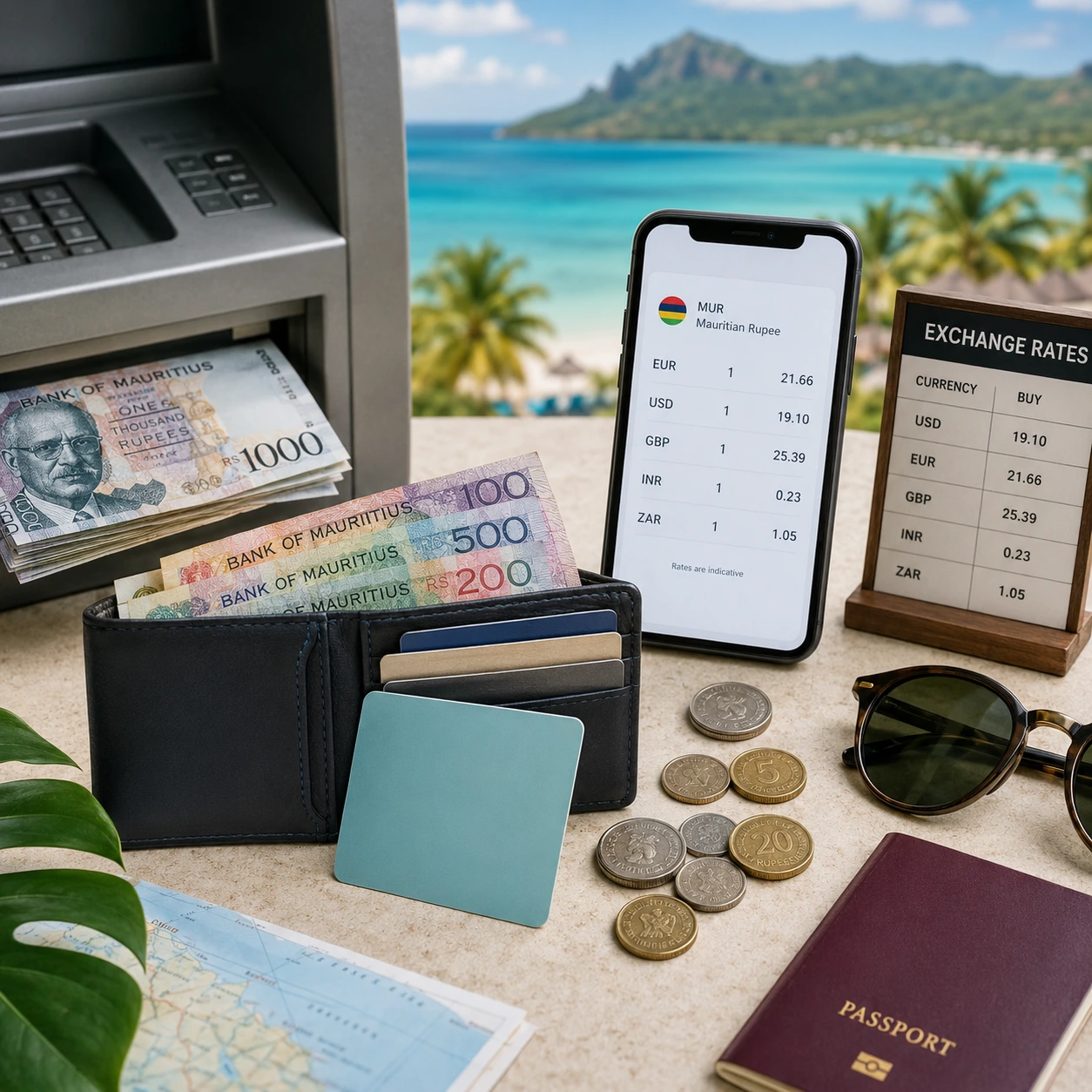
The official Mauritius currency is the Mauritian Rupee, shown internationally as MUR and locally as Rs.
For most travellers, managing money in Mauritius is simple. Carry some rupees for smaller businesses, markets and local purchases, while keeping a bank card available for hotels, restaurants, supermarkets and other established businesses.
You do not need to arrive with your entire trip planned around cash.
A better approach is to understand where cards work, where cash remains useful, how ATMs operate, and where to exchange foreign currency safely.
Here is what you need to know before you arrive.
What Currency Is Used in Mauritius?
The Mauritian Rupee is the official currency of Mauritius.
The Bank of Mauritius is responsible for issuing the country’s currency, and Mauritian currency issued by the Bank is legal tender in Mauritius.
You will see the currency written as:
- MUR
- Rs
- Mauritian Rupee
- Mauritian Rupees
Both paper and polymer banknotes can be found in circulation. The Bank of Mauritius has also introduced newer polymer notes alongside existing paper versions, so travellers should not be surprised if two notes of the same denomination look or feel slightly different. Both can remain valid legal tender.
For day-to-day travel, think in rupees rather than trying to pay businesses with foreign currency.
That keeps transactions simpler and avoids unnecessary confusion over conversion.
Should You Bring Cash to Mauritius?
Yes. Having some cash available makes using cash in Mauritius much easier when visiting places that do not rely heavily on card terminals.
Cash is useful for:
- Local markets
- Street-food vendors
- Small shops
- Local buses
- Small cafés
- Informal stalls
- Tips
- Purchases in less tourist-focused areas
At the same time, there is no need to rely entirely on cash.
Hotels, larger supermarkets, established restaurants, shopping centres and many tourism businesses accept cards.
The easiest setup for most visitors is therefore a combination of cash and card.
Keep enough cash for smaller everyday situations and use your card where it is clearly accepted.
Are Credit and Debit Cards Accepted in Mauritius?
Yes. Using cards in Mauritius is straightforward across much of the island’s established tourism infrastructure.
Major hotels, resorts, shopping centres, supermarkets and larger restaurants commonly provide card payment facilities.
Visa and Mastercard are the most practical cards to carry because they have broad international acceptance.
However, card acceptance becomes less predictable when you move away from larger businesses.
A roadside food stall, market vendor or small local shop can operate differently from a resort or shopping mall.
This is why carrying both payment methods works better than depending on one.
Before travelling, it is also sensible to:
- Tell your bank you are travelling if required
- Check that overseas transactions are enabled
- Know your card PIN
- Keep a backup payment method separate from your main wallet
- Make sure you can access your banking app while abroad
That last point matters if your bank asks you to approve a transaction or verify your identity while travelling.
Can You Use Contactless Payments in Mauritius?
Contactless payment is available at many modern card terminals, especially in hotels, supermarkets, restaurants and shopping centres in Mauritius.
However, you should not assume tap-to-pay will work everywhere.
Some merchants still use chip-and-PIN terminals, while smaller businesses can remain cash-focused.
If your phone supports a digital wallet, it can work where the merchant’s terminal and your card issuer both support the transaction.
But a phone alone is not the best payment plan for an entire Mauritius holiday. Carry a physical card and some rupee cash as backup.
Where Can You Get Mauritian Rupees?
Travellers have several options for obtaining Mauritius currency after arrival.
These include:
- Bank ATMs
- Licensed foreign-exchange bureaux
- Bank branches
- Airport foreign-exchange facilities
Foreign-exchange services are easier to find around major visitor and commercial areas such as Port Louis and Grand Baie, as well as around Sir Seewoosagur Ramgoolam International Airport.
The Bank of Mauritius publishes indicative exchange-rate information based on submissions from banks. Because currency values change, checking a current official or bank rate shortly before exchanging money gives you a better reference point than relying on an old travel article.
Avoid planning your holiday around a fixed exchange rate you saw several months before travelling.
Currency values move.
How Does Currency Exchange in Mauritius Work?
The safest approach to currency exchange in Mauritius is to use recognised banks or licensed exchange businesses.
Before agreeing to an exchange:
- Check the displayed rate
- Confirm what you will receive
- Ask about any conditions
- Count your money before leaving
- Keep the receipt where one is provided
Do not exchange money with unofficial individuals simply because they promise a better deal.
Convenience is not worth the risk of receiving incorrect amounts, invalid notes or having no record of the transaction.
If you are travelling with a major international currency, exchanging it through an authorised provider is far easier than relying on a less commonly traded currency.
Can You Withdraw Cash From ATMs in Mauritius?
Yes.
ATMs are available around Mauritius, particularly at:
- Bank branches
- Shopping centres
- Town centres
- Commercial areas
- Popular tourist zones
This makes withdrawing local Mauritius currency after arrival practical for most visitors.
Before using an ATM, check what your own bank does with overseas withdrawals and currency conversion.
Policies depend on your bank and card provider.
When an ATM or card terminal asks whether you want the transaction processed in your home currency or the local currency, read the screen carefully before confirming.
Do not simply press the first option.
Understanding which party performs the conversion helps you make a more informed choice.
For security, use ATMs located inside or directly beside recognised banks, malls or other busy locations where possible.
Is Cash or Card Better in Mauritius?
Neither is universally better. The best option depends on where you are.
| Situation | Practical payment method |
| Hotel or resort | Card |
| Large restaurant | Card |
| Supermarket | Card or cash |
| Local market | Cash |
| Street-food stall | Cash |
| Shopping centre | Card |
| Small local business | Keep cash available |
| Local bus | Cash is the safer option |
| Tourist activity booked ahead | Follow the operator’s stated payment method |
This combination removes most payment stress.
Someone spending an entire holiday inside a major resort has different needs from a traveller exploring local markets, villages and roadside food stops.
Your itinerary should determine how much you depend on cash.
Do You Need Foreign Currency After Arriving in Mauritius?
In most everyday situations, using money in Mauritius means paying in Mauritian Rupees or using an accepted card.
A business displaying information in another currency does not mean foreign cash is the best payment method.
When buying locally, think in MUR. It simplifies the transaction and makes it easier to compare what you are being asked to pay. This becomes particularly useful when moving between tourist areas and more local parts of the island.
Is Tipping Expected in Mauritius?
Tipping is appreciated in Mauritius, but travellers should not treat every interaction as requiring a tip.
The situation depends on the type of service and venue.
Hotels and restaurants can already include a service component, so check your bill before deciding whether you want to leave anything additional.
Travellers also choose to tip drivers, hotel staff and other service workers when they feel the service deserves recognition.
The key point is that tipping should feel voluntary rather than confusing or pressured. Keeping some smaller notes available makes this easier when you choose to tip.
Using Money at Markets and Local Shops
Markets are one of the clearest situations where using cash in Mauritius remains useful.
This includes places such as Port Louis Central Market and smaller local markets around the island.
Some established stalls can support electronic payments, but you should never assume every seller does.
Carry cash in a secure wallet and avoid displaying a large amount when making a small purchase.
If you are planning a day exploring Port Louis, local villages or traditional food spots, having rupees ready makes the day smoother. You can combine this with MoRide’s guide to things to do in Mauritius when planning stops beyond your resort.
Money Tips for Airport Arrivals
Sir Seewoosagur Ramgoolam International Airport is the first place many travellers deal with Mauritius currency.
You do not need to make every financial decision immediately after landing.
Instead:
- Keep your main card accessible
- Have a backup card stored separately
- Obtain some local currency if you need cash immediately
- Avoid carrying all your travel money in one place
- Check your bank app once your phone has data
- Keep important transaction notifications enabled
Transport should also be organised separately from your currency planning.
If you want your arrival journey arranged before landing, you can organise a Mauritius airport transfer so you already know how you are getting from the airport to your accommodation.
That removes one decision from the arrival process.
Keep Some Cash for Days Away From Your Resort
Mauritius is compact, but a sightseeing day can take you far from the large resorts and shopping centres where card facilities are easiest to find.
You could spend the morning in the mountains, stop at a roadside food stall and finish the day in a small coastal village.
For those days, cash becomes more useful.
This is particularly relevant if you are planning:
- A road trip
- Hiking
- Local food stops
- Market visits
- Small village stops
- Coastal sightseeing
- Early activity departures
Visitors joining a catamaran cruise in Mauritius should also check beforehand what payment arrangements apply to any extras they plan to purchase during the day.
Do that before departure rather than trying to solve it once you are already at the meeting point.
Keep Your Money and Cards Safe
Mauritius is straightforward to travel around, but the same basic financial habits that apply elsewhere still matter.
Keep your wallet secure in crowded places.
Do not carry every bank card together.
Store one backup card separately.
Avoid sharing your PIN.
Cover the keypad when entering it.
Check transaction alerts from your bank.
Use recognised ATMs.
Do not hand your card to someone unless it is necessary for a legitimate transaction.
And if a card is lost, contact the issuing bank quickly rather than waiting until the end of the day.
Simple preparation creates more protection than carrying excessive cash.
Travelling With Large Amounts of Currency
Mauritius has customs rules covering travellers carrying currency and other specified valuables above declaration limits.
The Mauritius Revenue Authority states that currency declarations can apply when entering or leaving Mauritius once the relevant threshold is reached.
Because customs rules can change, travellers carrying substantial amounts of cash or negotiable instruments should check the current Mauritius Revenue Authority requirements directly before travelling.
Do not rely on an old blog for a customs declaration limit.
Common Mistakes to Avoid With Money in Mauritius
A little preparation makes managing money in Mauritius much simpler.
Avoid these common mistakes:
- Depending entirely on cards
- Carrying only cash
- Assuming every small business accepts contactless payment
- Using unofficial currency changers
- Relying on an old exchange rate
- Keeping every card in the same wallet
- Leaving overseas card access disabled
- Forgetting how your bank handles international transactions
- Arriving at a market or local bus without cash
- Exchanging more currency than you realistically need at once
The goal is flexibility.
If one payment method does not work, you should already have another.
Know More About Mauritius Currency and Payments
How Much Cash Should I Carry Each Day in Mauritius?
Carry enough Mauritian Rupees for the cash-only parts of your planned day rather than carrying a large amount everywhere. A resort day requires little cash, while a market visit, street-food stop or journey involving local buses requires more. Keep the rest securely at your accommodation and carry a card as backup.
Do Taxis in Mauritius Accept Card Payments?
Do not assume every taxi accepts cards. Payment methods differ between operators and drivers. Confirm how you can pay when arranging the journey, especially for longer trips. For a pre-booked transfer, check the accepted payment method before pickup.
What Should I Do With Leftover Mauritian Rupees?
Avoid withdrawing or exchanging a large amount near the end of your holiday. Use remaining rupees for meals, small purchases, tips or other final expenses. If you still have a significant amount, check whether an authorised exchange provider can convert it before departure.
What Happens If an ATM Keeps My Card?
Contact the bank operating the ATM and your card issuer immediately. This is another reason to carry a second payment card separately from your main wallet. Avoid making your final available card the one you use for every ATM withdrawal.
How Much Cash Should I Withdraw From an ATM at Once?
Withdraw according to your upcoming spending needs rather than taking out your entire holiday budget. Your bank and the Mauritian ATM operator can apply their own transaction or withdrawal limits, so check the conditions shown before confirming the withdrawal.
Should I Carry Small Mauritian Rupee Notes?
Yes. Smaller notes are practical for street food, markets, small purchases, local transport and tips. They also prevent situations where a small vendor needs to find change for a much larger note.
Can I Exchange Mauritian Rupees After Leaving Mauritius?
Availability depends on the foreign-exchange provider in your destination country. The Mauritian Rupee is not exchanged as widely overseas as major international currencies. If you have a substantial amount left, dealing with it before leaving Mauritius is the simpler approach.
What Should I Do If My Card Is Declined in Mauritius?
Try another payment method rather than repeatedly attempting the same transaction. Check your banking app for security alerts, confirm international transactions are enabled, and contact your bank if the problem continues. Keeping a second card and some Mauritian Rupees available prevents one declined payment from disrupting your day.
Is tipping compulsory in Mauritius?
No. Tipping is discretionary. Check whether service is already included and then decide whether you want to recognise particularly good service.
Make Money One Less Thing to Worry About in Mauritius
Managing money in Mauritius does not need to become a complicated part of your holiday.
Use Mauritian Rupees for local cash payments.
Keep a card for businesses that accept electronic payments.
Carry a backup payment method.
Use recognised ATMs and licensed exchange providers.
And check current official information whenever exchange rates or customs rules matter.
Once the basics are sorted, you can focus on exploring the island rather than thinking about how you will pay at every stop.
MoRide Mauritius can also help make the movement side of your trip simpler, with pre-arranged transport for airport arrivals, sightseeing days and journeys between different parts of the island.

